

 The Wound
 Our History
 Why Me?
 Our Cultures
 My Response

NEW - Learn and Do resources
Ready-to-go activities, to save you time and engage your students
Find out more
NEW - Learn and Do resources
Find out moreKey Dates and Topics
NAIDOC Week 2023 – F-Y10 Understanding Eldership
This NAIDOC Week, watch the Understanding Eldership video with your students and then use this Activity Guide to explore the video in more detail using the discussion questions and activities provided. These questions and activities are suitable for students from Foundation to Year 10.
Early Years
Early Years Kinship
This resource explores the connections that exist between both family members and wider community networks. Through learning about First Nations kinship systems children build their understandings of the ways connections can contribute to an individual’s identity, feelings of belonging and overall sense of wellbeing.
Foundation
Foundation HASS, English, Health and PE & Dance – Exploring families, kinship and home
Starting with their own families, students explore ways of understanding family. They consider First Nations families and kinship and think about their own family as a continuous unit over time. The concept of Elders is used to highlight that everyone needs people who help them learn and be safe.
Year 1
Y1 Maths & Visual Arts – Patterns in First Nations cultures
Students explore the patterns linking their world with First Nations cultures, investigating patterns in nature, storytelling, language and counting systems. Students identify, create and interpret patterns, with a focus on the meaning and value in patterns for First Nations Peoples.
Year 2
Y2 Maths, Science & Visual Arts – Measurement on Country
Students explore length using both variable and uniform informal units of measurement and investigate ways First Nations people use measurement in everyday life. Students create a weaving artwork using informal measurement to share their learning with others.
Year 3
Y3 Maths, HASS & Design and Technologies – Living spaces
Students explore shapes through home design, and use drawing and modelling to create designs. They learn about First Nations architecture to understand the connection between design function and form, and consider the importance of designing homes to meet the needs of the household and environment.
Y3 Science, HASS & Health and PE – Heat transfer – now we’re cooking!
Students explore heat and heat transfer, identifying examples in their everyday lives, and observe cooking methods at home as examples of heat transfer. Students learn about First Nations cooking methods to better understand the cultural importance that‘s woven into the cooking and sharing of food in many communities.
Year 5
Y5 Music & HASS – Music as cultural expression
Students explore musical styles of First Nations musicians, the use of instruments and language/s in their music, and how culture can be shared through song. Students then create and present their own composition inspired by aspects of First Nations music explored in their learning.
Y5 HASS & Digital Technology – Impacts of feral animals
Students explore the impacts of feral animals on Country and culture, and the role First Nations rangers play in protecting Australia’s unique flora and fauna. Students use online research, flowcharts and algorithms, culminating with the creation of an ebook.
Y5 Media Arts & English – First Nations stories go digital
First Nations people are using media arts to share stories and keep culture strong. Students explore podcasts, music videos, animations, virtual reality and other media art projects that have been generated by Aboriginal and Torres Strait Islander creators. Students keep a blog (digital or written) to reflect on their learning each week.
Y5 HASS & English – Perspectives on colonisation
Students inquire into the impact of colonisation on people and places throughout the late 1700s and 1800s. They look at the causes and effects of change on different groups of people, particularly First Nations Peoples, and the environment. Students explore varying perspectives on key aspects of colonisation.
Y5 Science – Cultural ecology
Students explore how First Nations Peoples use knowledges of the structural features and behaviours of some animals and plants. They learn about Australia’s unique plant and animal diversity, and how First Nations Peoples to use and manage this through ancestral knowledge systems and practices.
Year 6
Y6 English – Themes in First Nations texts
In small reading groups students explore themes in novels by First Nations authors. They experience a story through the lens of the author and examine characters, settings and events. This learning is then applied in group discussion and writing activities.
Year 7
Y7 Languages – Connecting language to place
Through an examination of interconnected elements of identity, students build and apply knowledge of target language and culture. They explore First Nations People’s connection to Country and the way language, culture, family and place shape identity in all people.
Y7 History – First Nations aquaculture
Students learn about First Nations aquaculture practices and write inquiry questions to guide their research into significant sites. Through a Brewarrina Fish Traps case study, students draw conclusions about the site’s importance and show their findings in a multimodal presentation.
Y7 Science – Biological sciences: Indigenous classification and understanding food webs
Students compare and contrast First Nations Peoples’ different approaches to classifying organisms and the Western scientific approach known as the Linnaean system. They explore how different classification systems might inform our knowledge of the ecological interactions between organisms, including food chains and food webs.
Year 8
Y8 Languages – Connecting language to place
Through an examination of interconnected elements of identity, students build and apply knowledge of target language and culture. They explore First Nations People’s connection to Country and the way language, culture, family and place shape identity in all people.
Year 10
Y10 Science – The biological evolution of First Nations Peoples to the harsh Australian climate
The past tells how our ancestors migrated across the world and came to settle in Sahul. A story of resilience is uncovered through studying the biological evolution of First Nations Peoples. Genetic isolation and extreme climate changes have given rise to societies rich in archaeological histories.
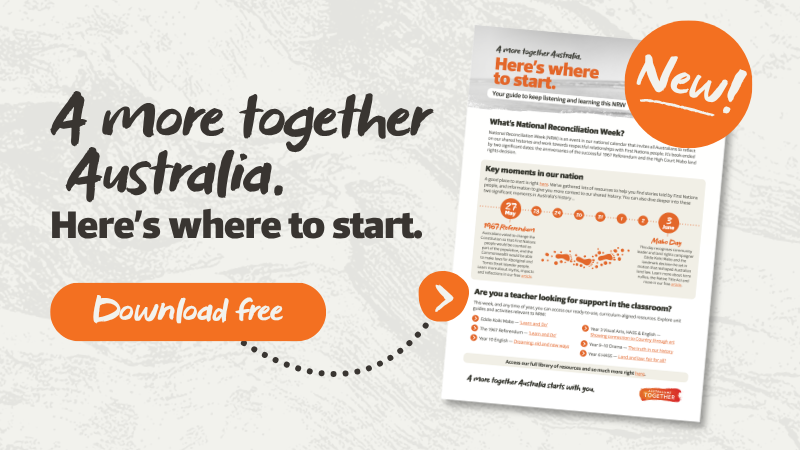
Free guide to National Reconciliation Week
Looking for some guidance this NRW? This free PDF includes handy links to articles and resources for anyone wanting to keep learning – so all your support is in one place.

Learn and Do - 'grab-and-go' activities
New curriculum resources designed to spark student engagement through interactive activities. Students will discover stories of remarkable First Nations people and explore key concepts like Country, connection and wellbeing.

Need custom curriculum resources for your school or organisation?
Our expert team of curriculum writers, First Nations cultural advisors, and academics can create high-quality resources tailored to your needs. We partner with schools and organizations to develop meaningful, culturally responsive materials.
Get in touch for a free quote on our curriculum development services.
Australians Together Learning Framework
Take a deep dive into the Learning Framework and explore our vast array of First Nations stories, activities, resources, and more. Curate your own customised learning journey to unlock the truth of our past, prompt reflection about our present, and inspire meaningful action that will bring about a brighter shared future for our nation.
Injustice from the impact of colonisation.
Discover our curated collection of stories, articles and statistics that expose the injustices at the heart of our nation.
Who are Indigenous Australians?
A past that shapes our story as a nation.
Tell stories that many Australians have never heard.
Immerse yourself in stories and articles to understand the connection between our nation’s past and present.
Busting the myth of peaceful settlement
Early missionaries to Australia
The civil rights movement in Australia


What’s it got to do with me?
Examines why this is relevant to every Australian.
Browse articles and stories that explore the ways we’re all connected, and what this means for us as Australians, collectively and individually.
What does this have to do with me?
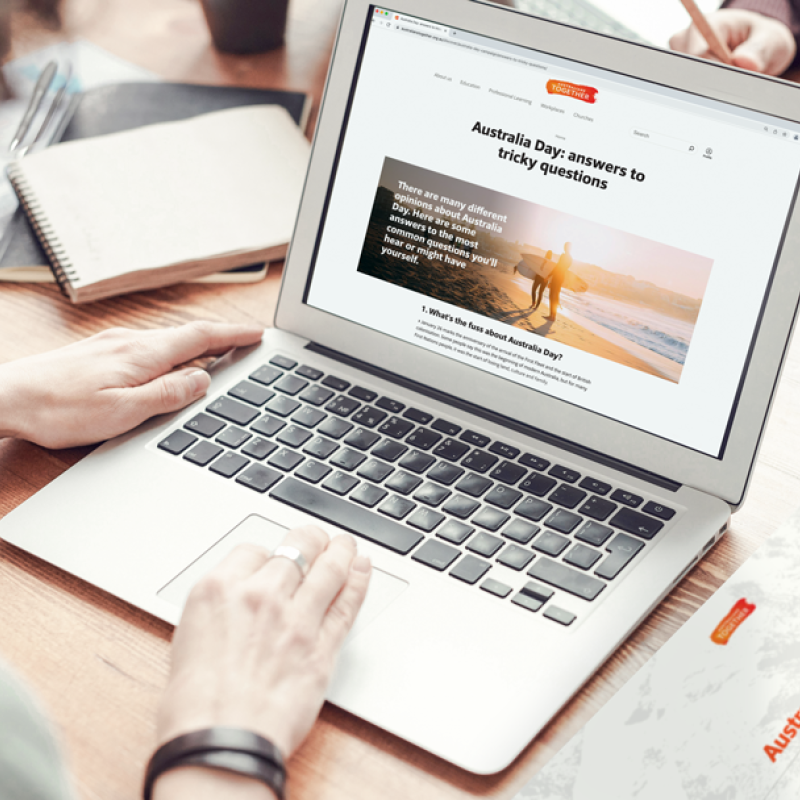
Australia Day: answers to tricky questions

Everyone has culture. Know about your culture and value the culture of others.
Dive into stories and articles that explore the significance of culture and its role in building a brighter future together.
Welcome to and Acknowledgement of Country
Steps we can take to build a brighter future.
Find inspiration in stories and articles that show even little steps can lead to big change when we do things together.
How do I get the most out of these resources?
The resources are designed to be flexible and modular, working around how you like to teach. You can use the resources exactly as they’re designed, or as a starting point from which to build your own lessons. Make them your own and use them to help you feel more confident in class.
Ready-made resources that save you time and help engage students
Make a difference in your classroom with easy-to-use, ready-made resources that will help your students understand First Nations stories, experiences and perspectives.

- Everything is ready to go
- Save you time
- Authentic learning

How will Australians Together continue to help me?
Change takes time and we’re here to provide the support you need over the long term. We’re constantly building new resources and we love to hear from educators like you. Feel free to reach out at any point and we can see how we can help. Together we can build a brighter future and a more united Australia for everyone.
Here’s why so many teachers love our resources:
- Everything is ready to go
Our resources include teacher guides and student handouts. - Save you time
Teachers love our resources as they it saves them time when lesson planning and they’re packed full of activities that really engage students. - Authentic learning
Teachers are following our resources’ responsive framework to confidently teach about Aboriginal and Torres Strait Islander histories, cultures and perspectives.
Have your say

Lets talk
We'd love to hear your feedback, comment or suggestions.
contact@australianstogether.org.au
Phone: (08) 7073 6499
PO Box 107
PARK HOLME SA 5043